Page 18: Dreamily the huts lay in the snow

Link to Page 18: Dreamily the huts lay in the snow
(Copyright 2009 by Klaus Conrad and Germancosm)

Verträumt lagen die Hütten im Schnee, friedlicher Lichtschein drang aus den Fenstern ... und wie wir dastanden und lauschten, trug uns der Nachtwind die schwachen Klänge einer Mandoline zu - "Heimatland, Heimatland!" - weit von der deutschen Heimat entfernt drang diese Melodie in die klare Märznacht Kanadas. "Wenn es uns gelingt, unbemerkt in jene Hütte zu kommen, dann sind wir für die nächsten Wochen vor der Polizei sicher", flüsterte Heinz. "Ja, die halten bestimmt dicht; ich möchte nur wissen, wie es hier draußen mit der Bewachung ist", entgegnete ich. Langsam pirschten wir uns näher an das Lager heran; es lag so still und friedlich da, alles schien in den Hütten zu sein - da, plötzlich schlägt ein Hund an, eine Taschenlampe blitzt auf, Schritte nähern sich. Mit einigen Sätzen sind wir seitwärts hinter einem Holzstapel verschwunden, kriechen im tiefen Schnee weiter - nur jetzt nicht geschnappt werden! Als wir für einen Augenblick verschnauften, war alles ruhig. Wir umschlichen das Lager, versuchten es von der anderen Seite.


Dreamily the huts lay in the snow, peaceful light glowed through the windows ... and, as we stood and listened, the night wind carried the faint sounds of a mandolin to us - "Heimatland, Heimatland!" - far away from the German homeland, this melody streamed out into the clear Canadian March night. "If we manage to slip into this hut unnoticed, then we'll be safe from the police for the next few weeks," whispered Heinz. "Yes, I'm sure they'll keep the secret; I just want to know what's up out here with the guards," I replied. Slowly we prowled toward the camp; it lay so peaceful and quiet, everyone seemed to be in the huts - there, suddenly a dog was alarmed, a flashlight lit up, footsteps approached. With a few leaps, we disappeared sideways behind a pile of wood, crawling farther through the deep snow - just don't get caught now! As we caught our breath for a moment, everything was silent. We crept around the camp, tried it from the other side.

0 comments, 0 trackbacks (URL) , Tags: page

Veterans Guard of Canada

Link to Veterans Guard of Canada
Canadian Military History Gateway

Although I mentioned the Veterans Guard before, the article linked yesterday has a description that's worth a post by itself. (paragraph breaks added)

As early as May 1940, the Department had created a new organization called the Veteran Guards of Canada. They assumed responsibility for guarding the captured soldiers in May 1941. The Veteran Guards consisted mostly of First World War veterans too old for battlefront duty. The maximum age for duty was fifty, but many slipped in despite their age.

Veteran Guard units were formed across Canada and they were assigned several different tasks ranging from guarding military targets, dams, bridges, power plants to government installations. The most important assignment, however, was guarding POW’s. From an initial limited recruitment of a few hundred men, the Veteran Guards of Canada expanded to over 10,000 by 1943 and was 15,000 strong by 1945.

At first glance, the aging First World War veteran seemed an unlikely candidate for guarding extremely well trained battle hardened enemy soldiers. Yet the guards possessed experience, and many had been POW’s themselves in WWI. They understood the prisoner mentality and the regimen of a controlled life. The Veteran Guards were used extensively in all parts of Canada including the bush camps located on Lake of the Woods.

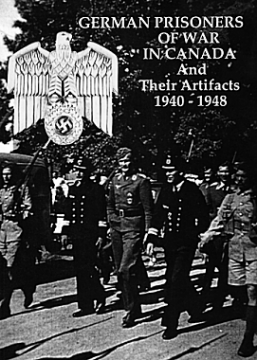
(The image is from a history page that mentions the Veterans Guards, and isn't related to the Lake of the Woods article.)

Related Posts:
   1. War Diary of Internment Camp No. 135: Jan 5-11, 1945 (Apr 19, 2010)
0 comments, 0 trackbacks (URL) , Tags: Canada

Hans Krakhofer's art from a POW lumberjack camp

Link to Hans Krakhofer's art from a POW lumberjack camp
Thunder Bay Historical Museum Society

Several local museums have made an effort to collect material relating to the history of German POWs in Canada and the US. For example, the Thunder Bay Historical Museum Society features a page on The Art of Hans Krakhofer. Some excerpts:

After spending nine months in a POW camp in England, Krakhofer was transferred to a camp in Monteith, Ontario, near the city of Timmins. ... the rough terrain of Northern Ontario was ideal for internment; there was little but bush to escape to.

In the Canadian camps conditions were generally good. Over the next 18 months at Monteith, Mr. Krakhofer took several university courses in navigation and mathematics, and continued to develop his artistic skills. Several of the works shown at left were done during his stay at Monteith.

In 1943, he volunteered to cut timber in a distant camp at Red Cliff Bay on the Lake of the Woods.

There's more in the article, including a sidebar with several other drawings.

0 comments, 0 trackbacks (URL) , Tags: artwork

Six POW logging camps in Ontario

Link to Six POW logging camps in Ontario
Lake of the Woods

Last Friday's book excerpt mentioned that many POWs worked in the logging industry. Fawcett Lake is in Alberta; here's some information from the other side of Canada.

The Ontario-Minnesota Pulp and Paper Company (O&M) built six camps in the Lake of the Woods area. Five camps were nestled throughout the bays and islands of Lake of the Woods. Two camps were situated on the Aulneau Peninsula. Camp 56 (Alfred Inlet), and camp 57 (Ghost Bay). Camp 61 was situated at Oak Point on the western peninsula. Camp 52 was at Red Cliff Bay (now POW Bay); and Camp 43 was on Adams River near Yellow Girl. The last work centre, Camp 60, was on Berry Lake. Each of the camps contained between 100-125 men and the POW’s were a mix of navy, air and army personnel with a few from the German merchant marine.

When the prisoners had cut their quota, usually by early afternoon, the rest of the day was spent on leisure activities. The range of leisure options seemed impressive. Soccer, hiking, and swimming. Building dug out canoes and kayaks and racing them passed many summer hours. The prisoners were allowed on fishing trips in the immediate vicinity of the camp. On these excursions it was not uncommon to meet US tourists and sell them handicrafts which they made over the winter. In the evenings, books, movies, cards, board games, music either played or from a gramophone, and letters from home or news from an illegal radio helped relieve boredom and loneliness. In the winter months ice soccer and ice fishing were enjoyed, as were hobbies such as wood carving and painting.

It's a long article, with lots of historical details.

0 comments, 0 trackbacks (URL) , Tags: Canada

"The Long Road to Repatriation"

Link to
ingridtaylar at Flickr

Here is part 8 in our series of recollections by Canadian Lt. Leo L. Hamson, regarding his time as a guard at the Wainwright POW camp. (minor typos corrected)

(The full set of Recollections is online, with photos.)


The Long Road to Repatriation

By March 1946 operations were winding down at Wainwright, and drafts of POWs were being shipped out on the long journey eastward and eventually back to the UK and the large POW holding camp at Lodgemoor near Sheffield. Many had accumulated substantial amounts of personal effects that they could not take with them, such as phonograph records, but mostly things they had made themselves - handicrafts, works of art, suitcases and the like. What they could not take they would have to dispose of. Their only hope of salvaging any value from it was to sell it to the Canadian camp staff for whatever they could get for it. They assembled it in what today would be like a garage sale.

For trivial sums I and other camp staff officers purchased a good deal of it, sometimes bidding against each other for the more desirable items. I bought a water-colour of one of the mediaeval gates of Rothenberg-ob-Tauber in Bavaria, a plaster wall plaque of one of Columbus’ ships by one of the few survivors of the Bismark, a well-crafted suitcase made of scraps of wood, a wooden chest as a toy box for my infant son, a leather-covered hand-wound Telefunken portable record player from Col. Hauk, the senior German officer, and a large collection of 78 RPM classical records in pristine condition in fine albums. Many of the POWs had written their names and POW numbers in the albums, crossing out the preceding name as the recordings were passed around as a sort of lending library. Phonograph needles were scarce, and they showed me how they made their own from the thorns of wild roses growing in the area. They sharpened these with sandpaper, and being softer than steel needles, they were kinder to the records.

When we were living in our isolated veterans’ settlement in the north with no electricity or access to recreation or entertainment, our group would meet in one of the rough houses we built and after a hard day’s work crank up Colonel Hauk’s Telefunken 78 RPM record player and listen to these prized recordings of classical music and opera, some of them sent from Germany. It enabled us to cling to some vestige of culture as we hacked our homesteads out of the wilderness of Northern Alberta.

About five years ago, when I discovered that there was a museum in the old Wainwright railway station devoted to the vanished POW camp, I donated many of these items to their meagre collection, including my Army uniform and some items of military equipment that I had stored away all these years. I still have the wall plaque and most of the record collection in excellent condition. Being 78 RPM they are never played now.

Copyright 2004 by Leo Hamson; used with permission

Related Posts:
   1. "The Long Road to Repatriation" (Aug 30, 2010)
0 comments, 0 trackbacks (URL) , Tags: book